
Snack Boards in the Classroom: A Fun Way to Teach Science, Math, and Design
Snack Boards in the Classroom: A Fun Way to Teach Science, Math, and Design
Sometimes the best classroom ideas start with something students already know.
Snack boards are everywhere — at parties, family gatherings, celebrations, and all over social media. But when we look a little more closely, there is actually a surprising amount of learning hidden behind a simple board of food.
Why do certain foods taste good together?
How do texture, color, and aroma affect what we choose to eat?
How much would a board cost to make?
Can you create something appealing while staying within a budget?
Those questions inspired a collection of snack board activities for Grades 4–7 that bring together science, math, reading, design, and real-world problem-solving.
Start With the Science
Before students ever design a snack board, they can begin by asking a very simple question:
Why do foods taste good together?
Food gives students an incredibly relatable way to explore science concepts.
Students can investigate how flavor, texture, color, aroma, and balance work together. They can think about why a crunchy cracker paired with creamy cheese feels different from eating either food alone, or why colorful foods may make a snack board more visually appealing.
This became the foundation for The Science of Snack Boards.
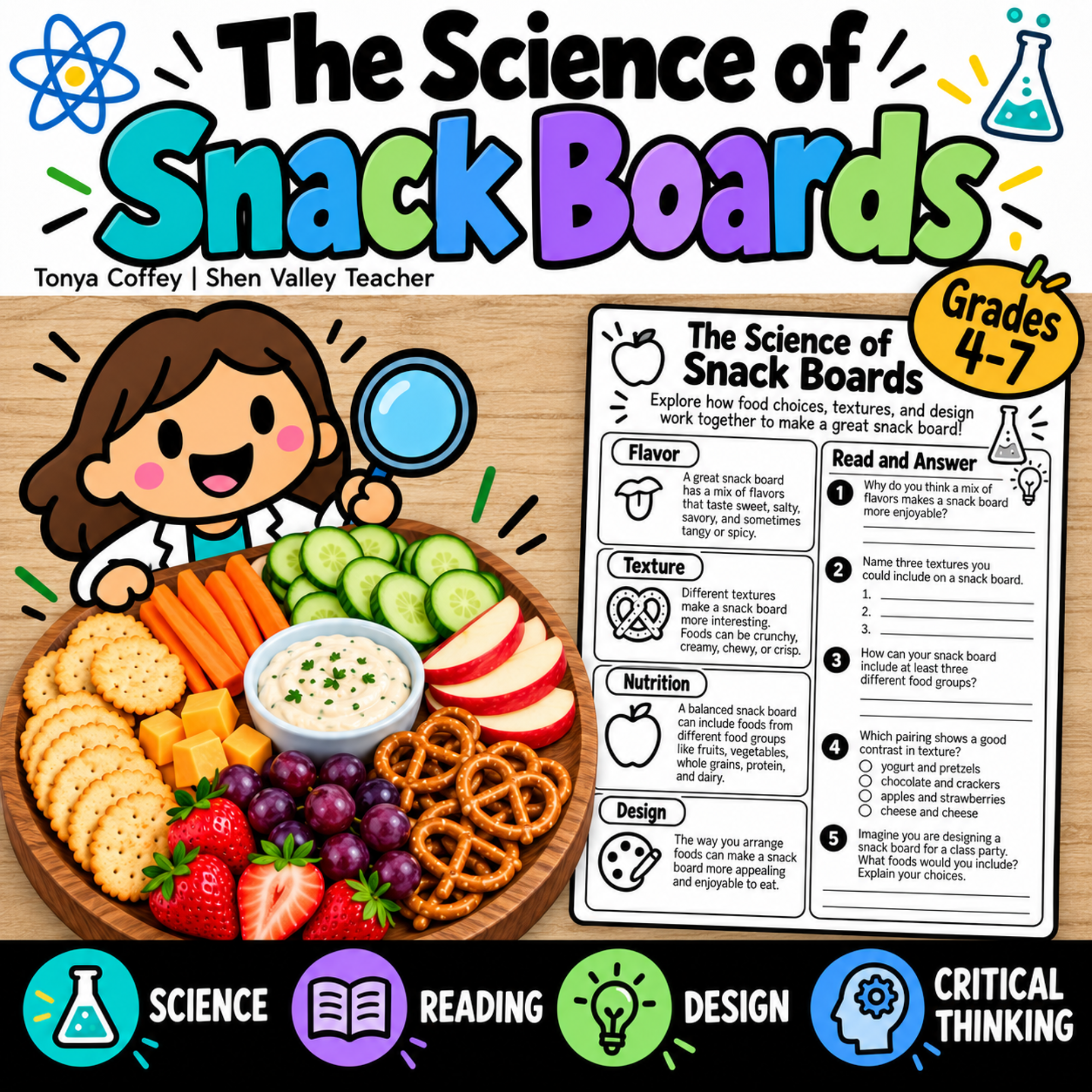
Students explore:
the five basic tastes, including sweet, salty, sour, bitter, and umami
different food textures
the role of color and aroma
how contrasting foods can complement one another
how different elements work together to create a balanced snack board
Then they apply what they learned by designing their own board and explaining their choices. What I love most is that the science does not stay on the page. Students have to use it to make a decision.
Add Real-World Math With a BOO Board
Once students understand the design behind a snack board, it becomes easy to add another layer of learning: money and budgeting. That is where the BOO Board Challenge came from.
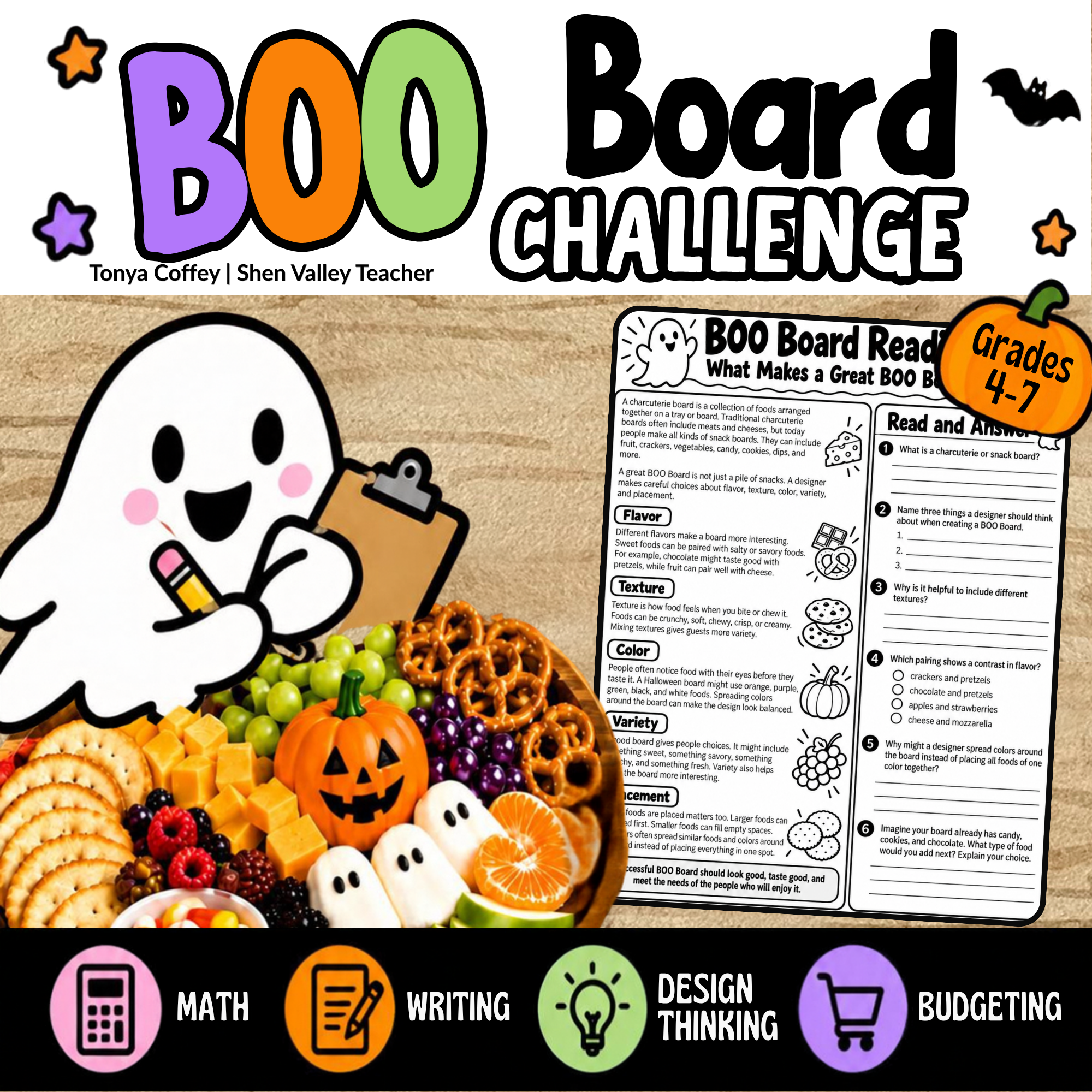
Students become the designers of a Halloween-themed snack board, but there is a catch: they have a budget.
They must choose foods, calculate costs, compare their total to the available budget, make adjustments, and consider how much their board will cost per guest. Suddenly, decimal operations have a purpose.
Instead of completing a page of unrelated calculations, students are using math to answer questions such as:
Can I afford everything I want?
What should I change if I go over budget?
How much will this cost for each guest?
Which choice gives me the best value?
The project also incorporates reading, planning, reflection, design, and persuasive writing, with differentiated materials for Grades 4–5 and Grades 6–7.
And no actual food is required. Students can complete the entire challenge on paper, although teachers could certainly turn it into a classroom celebration or extension activity if they choose.
Let Students Think Like Designers
One of my favorite parts of both projects is that there isn't a single correct snack board. Students have choices. They have to consider an audience, make decisions, revise their ideas, and explain their thinking. That makes these activities more than a cute seasonal project.
Students are practicing the same kinds of thinking we want them to use in STEM:
Plan → Make a decision → Test the idea → Revise → Explain
And because the context is familiar, students can focus on thinking rather than first having to understand a complicated scenario.
Try It First With a Free Mini Challenge
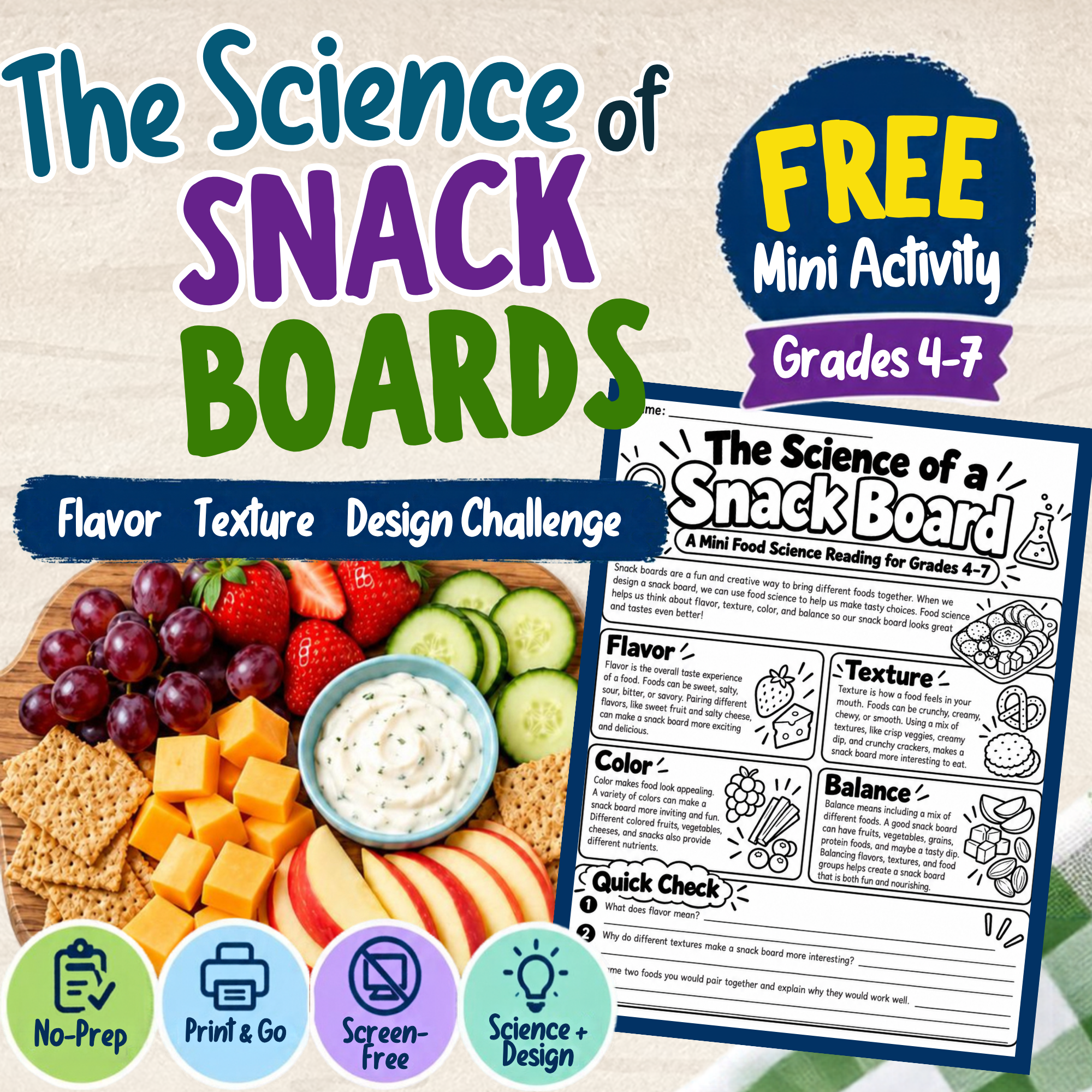
If you want to introduce the idea without committing to a larger project, I also created a FREE Snack Board Mini Design Challenge.
Students read a short introduction to the science of snack boards, think about flavor, texture, color, and variety, and then design and explain a five-food snack board.
It works well as:
a quick STEM activity
an early finisher
a science and reading connection
a sub activity
an introduction to food science
a lead-in to one of the larger snack board projects
Three Ways to Use the Resources
You could use each resource independently, but they also make a natural learning progression.
Start: FREE Snack Board Mini Design Challenge
Students get a quick introduction to food science and design.
Explore: The Science of Snack Boards
Students dig deeper into flavor, texture, color, aroma, and balance before completing a larger design challenge.
Apply: The BOO Board Challenge
Students combine design with budgeting, math, reading, writing, and real-world decision making in a Halloween-themed project.
For me, that is where project-based learning becomes especially powerful. The goal is not simply to make something fun. The fun context gives students a reason to read, calculate, question, design, communicate, and revise. And if they happen to get excited about creating a snack board along the way? Even better.
Ready to Try a Snack Board Challenge?
You can find all three resources in my Shen Valley Teacher store on Teachers Pay Teachers:
FREE Snack Board Mini Design Challenge
A quick introduction to food science and snack board design.
The Science of Snack Boards
A deeper exploration of flavor, texture, color, aroma, balance, and design for Grades 4–7.
The BOO Board Challenge
A Halloween project combining budgeting, math, reading, design, persuasive writing, and reflection for Grades 4–7.